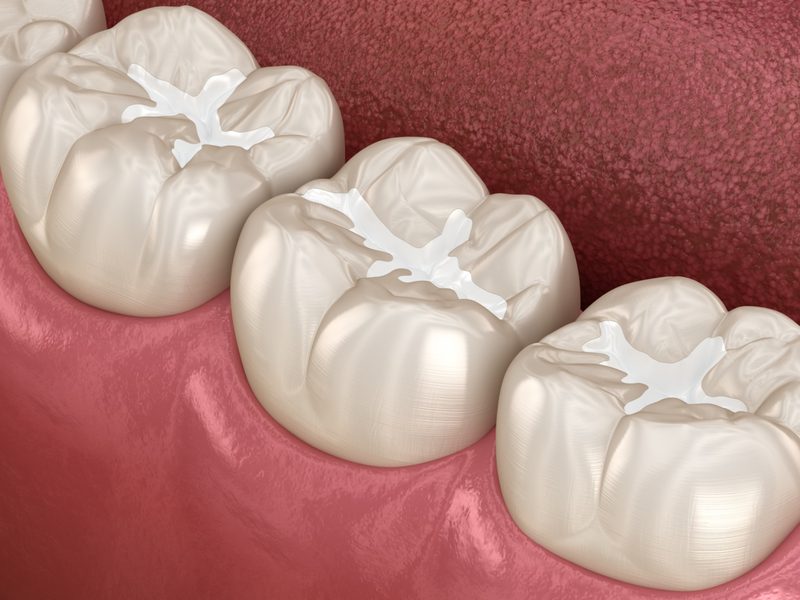
Dental sealants are thin, protective coatings applied to the chewing surfaces of the back teeth — the molars and premolars — to shield them from decay. Made from a safe, tooth-colored resin material, sealants flow into the deep grooves and pits on the biting surfaces of these teeth and harden into a smooth, protective barrier that keeps bacteria and food particles from settling in and causing cavities.
The procedure is quick, completely painless, and requires no drilling or removal of tooth structure — making it one of the simplest and most effective preventive treatments available in dentistry. Sealants are most commonly associated with children, but they can be a valuable protective measure for teenagers and adults as well.
To appreciate why sealants are so effective, it helps to understand the unique vulnerability of the back teeth. The molars and premolars have highly irregular chewing surfaces covered with a complex landscape of hills, valleys, grooves, and pits — called fissures — that are designed to help grind and break down food. While this anatomy is excellent for chewing, it creates a significant challenge for oral hygiene.
Many of these grooves are extremely narrow — so narrow that the bristles of a toothbrush cannot physically reach the bottom of them. Food particles and bacteria collect in these crevices, protected from brushing and largely untouched by saliva’s natural cleansing action. Over time, the bacteria produce acids that attack the enamel at the base of these grooves, and cavities begin to form in areas that are virtually impossible to clean no matter how carefully a patient brushes.
Sealants address this vulnerability directly by filling in and sealing off these grooves before decay has a chance to take hold. Specifically, sealants help with:
- Cavity prevention on molar and premolar surfaces: The chewing surfaces of the back teeth account for a disproportionately large share of all cavities — particularly in children and teenagers. Sealants reduce this risk dramatically by creating a smooth, sealed surface that is easy to clean and inhospitable to bacterial accumulation.
- Protecting newly erupted permanent teeth: The years immediately following the eruption of permanent molars are the highest-risk period for pit and fissure decay. Applying sealants shortly after these teeth emerge provides protection during the most vulnerable window, before decay has any opportunity to begin.
- Arresting very early decay: In some cases, sealants can be applied over the earliest stage of a cavity — where decay has just begun to affect the outermost layer of enamel but has not yet progressed into a full cavity requiring a filling. By sealing the area and cutting off the bacteria’s access to nutrients, the progression of the decay can be halted.
- Reducing the need for future restorative treatment: Every cavity that is prevented by a sealant is a filling, crown, or more extensive treatment that never needs to happen. Sealants are a small upfront investment that can prevent significantly larger dental expenses down the road.
- Protecting patients with deep grooves: Some patients — regardless of age — have naturally deeper or more complex groove anatomy than average, making them inherently more susceptible to pit and fissure decay. Sealants are particularly beneficial for these individuals.
- Supporting patients with difficulty maintaining oral hygiene: Children who are still developing their brushing technique, patients with physical or cognitive limitations that make thorough oral hygiene challenging, and anyone who struggles to maintain consistent home care can benefit significantly from the added protection sealants provide.