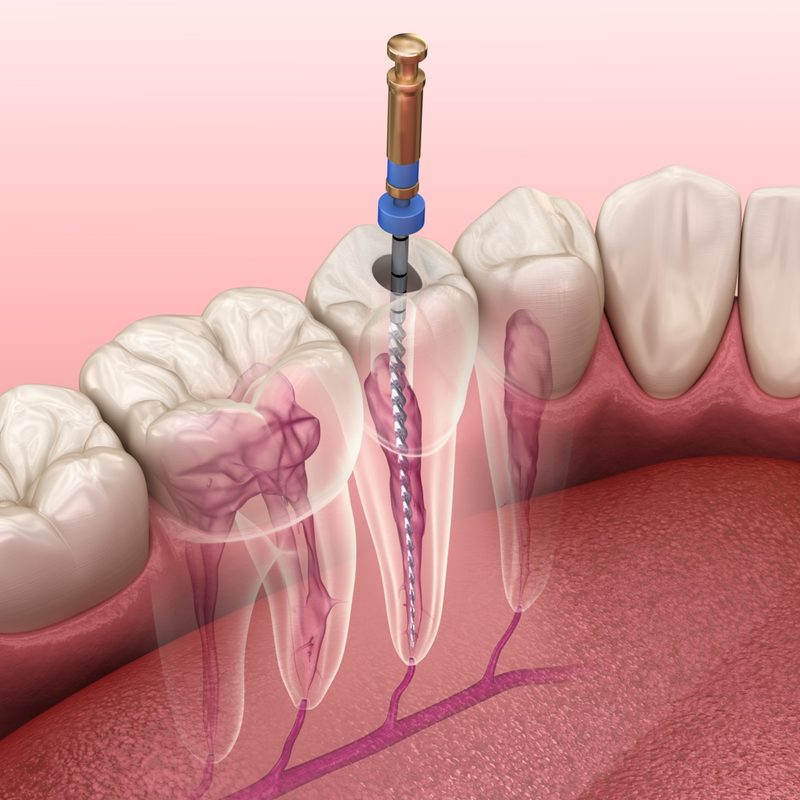
Root canal treatment — also called endodontic therapy — is a procedure that removes infected, inflamed, or damaged tissue from the inside of a tooth, cleans and disinfects the inner canal system, and seals it permanently to prevent reinfection. Rather than removing the tooth entirely, root canal treatment saves it — allowing a tooth that would otherwise need to be extracted to remain in the mouth, fully functional, for many years or even a lifetime.
The term “root canal” refers to the natural hollow spaces within a tooth that house the dental pulp — a soft tissue containing nerves, blood vessels, and connective tissue that nourishes the tooth during its development. When this pulp becomes infected or irreversibly inflamed, it can no longer heal on its own, and treatment is necessary to eliminate the infection, relieve pain, and preserve the tooth.
Root canal treatment is one of the most misunderstood procedures in dentistry. For decades it carried a reputation for being painful and dreaded — a reputation that modern techniques, advanced instruments, and effective anesthesia have made largely obsolete. The overwhelming majority of patients who undergo root canal treatment today report that the procedure was far more comfortable than they expected, and that the relief it provides from pre-existing pain and infection is immediate and significant.
Root canal treatment becomes necessary when the dental pulp — the living tissue inside the tooth — has become irreversibly damaged, infected, or has died. This can occur for a number of reasons:
- Deep tooth decay: The most common cause of pulp involvement. When a cavity is left untreated for long enough, the decay progresses through the outer enamel and dentin layers of the tooth and eventually reaches the pulp chamber at the center. Once bacteria invade the pulp, infection sets in and the tissue can no longer recover on its own.
- Dental abscess: A dental abscess is a pocket of infection — a collection of pus — that forms at the tip of the tooth root as a result of pulp infection spreading beyond the tooth itself into the surrounding bone. Abscesses cause significant pain, swelling, and in serious cases can spread to other areas of the head and neck. Root canal treatment eliminates the source of the abscess and allows the surrounding tissue to heal.
- Cracked or fractured tooth: A crack that extends deep enough into the tooth to reach the pulp allows bacteria to enter and infect the inner tissue. Depending on the location and severity of the crack, root canal treatment may be needed to address the resulting pulp damage.
- Traumatic injury: A blow to the tooth — from a fall, sports impact, or accident — can damage or sever the blood supply to the pulp even without visibly fracturing the tooth. In some cases the pulp dies gradually following trauma, a process that may not become apparent for months or even years after the original injury. A tooth that has darkened in color following trauma is often a sign that the pulp has died and treatment is needed.
- Repeated dental procedures: A tooth that has undergone multiple restorations over the years — repeated fillings, replacements, and repairs — can experience cumulative irritation to the pulp that eventually leads to inflammation and failure. Each time a tooth is worked on, the pulp sustains some degree of stress, and for some teeth this accumulates to the point where the pulp can no longer recover.
- Severe or prolonged inflammation: In some cases, significant pulp inflammation — called irreversible pulpitis — occurs without an obvious single cause. The pulp becomes chronically inflamed to the point where it cannot heal, and root canal treatment is needed to resolve the condition.
Signs and symptoms that may indicate root canal treatment is needed include:
- Persistent, severe toothache — particularly throbbing or spontaneous pain that occurs without an obvious trigger
- Prolonged sensitivity to heat or cold that lingers for more than a few seconds after the stimulus is removed
- Pain when biting or chewing on the affected tooth
- Darkening or discoloration of the tooth
- Swelling, tenderness, or a raised bump on the gum near the affected tooth — sometimes called a dental fistula or “gum boil” — which is a sign that infection is draining from the root tip
- A persistent bad taste or odor that does not resolve with normal oral hygiene
It is important to note that in some cases — particularly when the pulp has died completely — a tooth requiring root canal treatment may be entirely painless. This is why regular dental checkups and X-rays are essential for detecting pulp pathology even in the absence of symptoms.