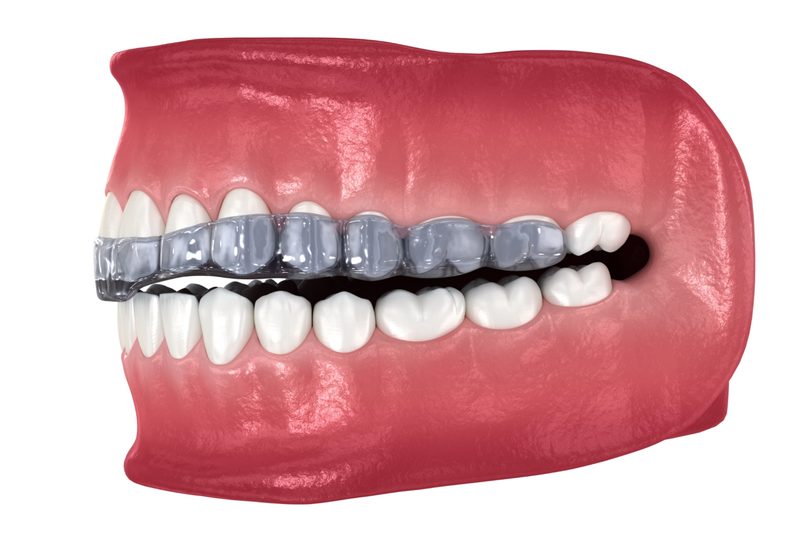
Occlusal guards do not cure bruxism — they do not stop the grinding or clenching from occurring. What they do is intercept the damaging consequences of bruxism and provide a protective environment in which the teeth, restorations, and jaw structures are shielded from harm. They also play an important role in managing the pain and discomfort that bruxism can produce.
Tooth Wear and Attrition
This is perhaps the most visually apparent consequence of untreated bruxism. The repeated grinding of teeth against each other wears away the enamel — the hardest substance in the human body — at a rate far exceeding normal wear from chewing. Over years and decades of unmanaged grinding, teeth can become dramatically shortened, flattened, and thinned. The biting edges of front teeth may become straight and angular rather than gently curved. The chewing surfaces of back teeth lose their natural contours. In severe cases, the enamel is worn completely through, exposing the softer dentin beneath — which wears even faster — and leaving teeth sensitive, discolored, and structurally vulnerable.
Tooth wear from bruxism is irreversible. Once enamel is lost, it does not grow back. An occlusal guard protects against further wear by providing a sacrificial surface — the guard material absorbs the grinding forces rather than the tooth surfaces.
Cracked and Fractured Teeth
The intense, repetitive forces of bruxism — particularly clenching — can cause teeth to crack. Cracks in teeth are insidious because they often develop slowly and silently, causing intermittent sharp pain when biting in certain ways before becoming apparent on examination. A tooth that has cracked significantly may require a crown to hold it together — and if the crack extends into the root, the tooth may be lost entirely. Heavily ground or clenched teeth are also more susceptible to outright fracture — the sudden breaking of a portion of the tooth — particularly teeth that have been previously restored with large fillings or that have underlying structural compromise.
Damage to Dental Restorations
Crowns, veneers, composite bonding, implant crowns, and other dental restorations are all subject to damage from bruxism. Porcelain veneers and ceramic crowns can chip or fracture under grinding forces. Composite restorations wear more rapidly in bruxers than in patients without the habit. Implant components can loosen or fracture under excessive occlusal load. An occlusal guard protects existing restorations — preserving their longevity and reducing the need for costly repairs and replacements.
Temporomandibular Joint Disorder
The temporomandibular joints — the hinge joints on either side of the face that connect the lower jaw to the skull — bear significant load during bruxism. Chronic grinding and clenching can strain the muscles, ligaments, and disc structures within and around these joints, contributing to a constellation of symptoms collectively called temporomandibular joint disorder — commonly abbreviated TMD or TMJ disorder. Symptoms of TMD include:
- Pain or tenderness in the jaw joint area, in front of the ear, or in the muscles of the face, temples, or neck
- Clicking, popping, or grating sounds when opening or closing the mouth
- Locking or limited opening of the jaw
- Headaches — particularly upon waking — caused by nighttime muscle overactivity
- A feeling of fatigue or tightness in the jaw muscles
An occlusal guard reduces the load on the temporomandibular joints and relaxes the muscles of mastication — the chewing muscles — by holding the jaw in a slightly open, decompressed position that reduces joint compression and muscle tension.
Headaches and Muscle Pain
Many patients who grind or clench their teeth — particularly during sleep — wake with headaches, facial pain, or jaw muscle soreness. These symptoms are caused by the sustained, high-intensity contraction of the powerful muscles responsible for closing the jaw — the masseter, temporalis, and pterygoid muscles — throughout the night. These muscles can become fatigued, tender, and hypertrophied — noticeably enlarged — in patients with severe bruxism. An occlusal guard reduces the intensity of muscle contraction during sleep and allows the muscles to rest more effectively, leading to significant reduction in morning headaches and facial pain for many patients.
Protecting Dental Implants
Dental implants are particularly vulnerable to the effects of bruxism. Natural teeth have a small degree of natural cushioning — provided by the periodontal ligament — that absorbs and distributes occlusal forces. Implants, which are fused directly to the bone without a periodontal ligament, lack this shock-absorbing mechanism and transmit forces directly to the surrounding bone. Excessive force from bruxism can stress the bone-implant interface, loosen implant components, and in severe cases contribute to implant failure. Patients with dental implants who also have bruxism are strongly advised to wear an occlusal guard to protect their implant investment.
Managing Post-Orthodontic Retention
For some patients, an occlusal guard can serve a secondary function of providing mild retention of teeth following orthodontic treatment — though this is not its primary purpose, and dedicated retainers remain the appropriate primary tool for retention.