Dental Services

Dental Extractions: What They Are and What to Expect

What Is a Dental Extraction?

A dental extraction is the careful removal of a tooth from its socket in the jawbone. While preserving natural teeth is always the first priority in dentistry, there are situations in which a tooth is too damaged, diseased, or problematic to save — and in these cases, removal is the most appropriate path forward to protect your oral health and overall wellbeing. Modern dental techniques, effective anesthesia, and thoughtful post-operative care make the extraction process far more comfortable and manageable than many patients anticipate.

Extractions are performed by general dentists for straightforward cases and by oral surgeons for more complex situations. In either setting, patient comfort and safety are the highest priorities throughout the procedure.

What Do Dental Extractions Treat?

There are many reasons a tooth may need to be removed. The most common include:

  • Severe tooth decay: When decay has destroyed so much of a tooth’s structure that it cannot be restored with a filling, crown, or other restoration, extraction may be the only remaining option. Leaving a severely decayed tooth in place risks the spread of infection to surrounding teeth and bone.
  • Advanced gum disease: Periodontitis — the most serious form of gum disease — destroys the bone and connective tissue that anchor teeth in the jaw. When this support is lost to the point that a tooth becomes loose, painful, or functionally compromised, extraction is often necessary to eliminate the source of infection and prevent further damage to the surrounding structures.
  • Cracked or fractured teeth: A tooth that has cracked or fractured below the gumline, or in a way that cannot be reliably restored, may need to be removed. Deep fractures that extend into the root are particularly difficult to treat and often cannot be saved even with root canal treatment and a crown.
  • Dental abscess or infection: A severe infection at the root of a tooth or in the surrounding bone can pose a serious health risk if left untreated. When root canal treatment is not possible or has failed to resolve the infection, extraction removes the source of the problem and allows the surrounding tissue to heal.
  • Impacted wisdom teeth: The third molars — commonly called wisdom teeth — are the last teeth to emerge, typically between the ages of 17 and 25. In many patients, there is insufficient space in the jaw for these teeth to erupt properly. They may become partially or fully trapped — impacted — beneath the gum or within the bone, leading to pain, infection, damage to neighboring teeth, cyst formation, or other complications. Removal of impacted wisdom teeth is one of the most commonly performed oral surgical procedures.
  • Orthodontic treatment planning: When the jaw is too crowded to allow teeth to align properly, one or more teeth may be strategically removed to create the space needed for remaining teeth to move into their correct positions during orthodontic treatment.
  • Baby teeth that fail to fall out: Occasionally, a primary — baby — tooth does not fall out on its own schedule, blocking the path of the incoming permanent tooth beneath it. Removing the retained baby tooth allows the permanent tooth to erupt normally.
  • Supernumerary teeth: Some patients develop extra teeth — called supernumerary teeth — beyond the normal complement. These additional teeth can crowd the dental arch, block permanent teeth from erupting, or cause other structural problems and are typically removed.
  • Teeth damaged beyond repair by trauma: A tooth that has been severely fractured, displaced, or otherwise damaged by an injury — such as a fall, accident, or sports impact — may be too compromised to restore and require extraction.
  • Pre-radiation or pre-transplant preparation: Patients preparing for head and neck radiation therapy or organ transplantation may need to have compromised teeth removed beforehand, as these procedures significantly affect the body’s ability to heal from dental infections or procedures afterward.
dental-extractions

Types of Dental Extractions

Not all extractions are the same. The complexity of the procedure depends on the location, condition, and position of the tooth being removed.

Simple Extraction

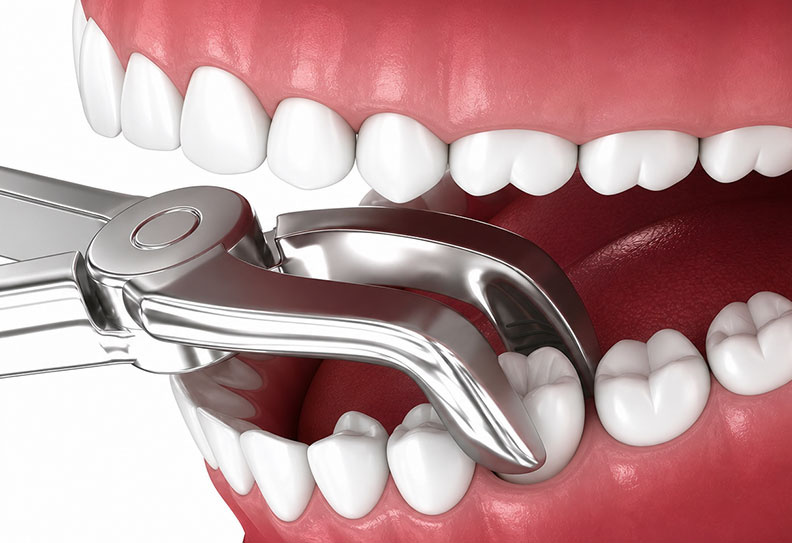
A simple extraction is performed on a tooth that is fully visible above the gumline and can be removed in one piece using specialized instruments. The dentist loosens the tooth within its socket using an instrument called an elevator, then gently removes it with forceps. Simple extractions are routine procedures completed under local anesthesia in a single appointment, often in just a few minutes.

Surgical Extraction

A surgical extraction is required when a tooth is more difficult to access or remove — for example, when it is impacted beneath the gum, broken off at the gumline, has curved or unusually shaped roots, or is firmly anchored in dense bone. In these cases, a small incision is made in the gum tissue to access the tooth. The tooth may need to be sectioned — carefully divided into smaller pieces — before each section is removed individually. Surgical extractions may be performed by a general dentist or referred to an oral and maxillofacial surgeon depending on the complexity of the case.

Wisdom Tooth Extraction

Wisdom tooth removal deserves special mention as it is among the most frequently performed surgical extractions. Depending on the position and depth of the impacted tooth, the procedure may range from a relatively straightforward surgical extraction to a more involved procedure requiring significant bone removal. Wisdom tooth extractions are often performed with the patient under local anesthesia, IV sedation, or general anesthesia depending on the complexity and the patient’s preference and anxiety level.

How Is a Dental Extraction Performed?

Before the Procedure — Evaluation and Planning
Before any extraction, your dentist or oral surgeon will take X-rays to assess the position, shape, and depth of the tooth’s roots, evaluate the surrounding bone, and identify any anatomical structures — such as nerves or sinuses — that need to be considered during the procedure. Your medical history, current medications, and any allergies will be reviewed carefully, as certain conditions and medications can affect how an extraction is performed and how you heal afterward.

If you take blood thinners, have heart conditions requiring antibiotic premedication, or have other significant medical considerations, your dental team will coordinate with your physician as needed before proceeding.

Sedation options will be discussed so you can choose the level of comfort and relaxation that is right for you.

1

Anesthesia and Comfort

Local anesthesia is administered to completely numb the tooth, surrounding gum tissue, and bone before any instrumentation begins. Your dentist will first apply a topical anesthetic gel to the gum to minimize the sensation of the injection itself. Once the anesthetic takes effect — typically within a few minutes — the area will be thoroughly numb. You may feel pressure and movement during the procedure, but you should not feel sharp pain. If at any point you feel discomfort beyond pressure, you should signal your dentist immediately so that additional anesthetic can be administered.

For patients undergoing surgical extractions, wisdom tooth removal, or multiple extractions, sedation options — including nitrous oxide, oral sedation, or intravenous sedation — can be arranged to provide a more relaxed and comfortable experience.

2

Loosening the Tooth (Simple Extraction)

For a simple extraction, your dentist uses a specialized instrument called a dental elevator to gently work around the tooth and loosen it within its socket. The periodontal ligament — the fibrous tissue that attaches the tooth root to the surrounding bone — must be broken down to allow the tooth to be freed. This process involves careful, controlled rocking and rotating movements that gradually expand the socket and release the tooth’s attachment. You will feel pressure and movement during this stage — this is completely normal.
3

Incision and Access (Surgical Extraction)

For a surgical extraction, your dentist or oral surgeon makes a small, precise incision in the gum tissue overlying the tooth to expose the underlying tooth and bone. In cases where bone is covering the tooth — as is common with deeply impacted wisdom teeth — a small amount of bone may be carefully removed using a surgical handpiece to gain adequate access to the tooth.
4

Tooth Removal

Once the tooth has been sufficiently loosened — or surgically accessed — it is grasped with extraction forceps and removed from the socket with controlled, deliberate movements. If the tooth has multiple roots or is being removed surgically, it may be sectioned into two or more pieces using a surgical handpiece, with each piece removed individually. Sectioning the tooth reduces the force required for removal and minimizes trauma to the surrounding bone and tissue.
5

Socket Management

After the tooth is removed, the socket is gently cleaned to remove any debris, infected tissue, or remnants of the periodontal ligament. If a surgical incision was made, the gum tissue is repositioned and closed with sutures — stitches — that dissolve on their own over the following one to two weeks. A folded piece of sterile gauze is placed over the extraction site and you will be asked to bite down firmly on it to apply pressure and help initiate clot formation.

In some cases, particularly where bone loss is present or a future implant is planned, your dentist may place a bone grafting material into the socket before closing it. This material helps preserve the volume and shape of the jawbone in the area, making future implant placement more successful.

6

Post-Operative Instructions

Before you leave the office, your dental team will provide detailed written and verbal instructions covering everything you need to know about the healing process — including how to manage bleeding, swelling, and discomfort, what to eat and drink, how to keep the area clean, and which activities to avoid. These instructions are an important part of your care and following them closely significantly reduces the risk of complications.
What Can You Expect Afterward?

Recovery from an extraction varies depending on the complexity of the procedure, the tooth involved, and individual factors. Most patients recover comfortably with straightforward home care.

The First 24 Hours
The first 24 hours after an extraction focus on clot formation and initial healing. A blood clot forms in the empty socket and serves as the foundation for the healing tissue that will eventually fill the space. Protecting this clot is the most important priority in the immediate post-operative period.

During this time:

  • Bite firmly on gauze for the first 30 to 45 minutes after leaving the office to control bleeding. If bleeding continues, replace the gauze and maintain firm pressure. A small amount of blood mixing with saliva — causing it to appear quite red — is normal and not cause for alarm.
  • Avoid rinsing, spitting forcefully, or using a straw for the first 24 hours. The suction created by these actions can dislodge the forming clot.
  • Do not smoke for at least 48 to 72 hours — ideally longer. Smoking dramatically increases the risk of complications and delays healing.
  • Apply ice packs to the outside of the face over the extraction site in 20-minute intervals during the first 24 hours to manage swelling.
  • Rest and avoid strenuous activity for the remainder of the day.
  • Eat soft foods — yogurt, applesauce, mashed potatoes, smoothies — and avoid chewing near the extraction site.

Days 2 Through 7
Swelling typically peaks around 48 to 72 hours after the procedure and then gradually subsides. Some bruising of the skin over the jaw is normal, particularly after surgical extractions, and will fade over the following week. Discomfort is usually most noticeable in the first two to three days and can be managed effectively with over-the-counter pain relievers such as ibuprofen or acetaminophen, or with a prescription pain medication if provided by your dentist.

Beginning 24 hours after the extraction, gentle warm saltwater rinses — half a teaspoon of salt dissolved in eight ounces of warm water — can be used after meals to keep the area clean and support healing. Brushing and flossing can resume normally in areas away from the extraction site.

Most patients feel significantly better within three to five days and return to normal activities within a day or two of the procedure, though complete tissue healing takes several weeks.

Suture Removal
If non-dissolving sutures were placed, a follow-up appointment will be scheduled approximately one week after the extraction to remove them. Dissolving sutures do not require removal and will break down and disappear on their own.

Having a tooth extracted is never the first choice — but when it is the right choice, it is an important step toward a healthier, more comfortable mouth. With modern techniques, effective anesthesia, and the guidance of your dental team, the experience is far more manageable than most patients expect — and the relief that follows is often immediate and profound. Your dental team will support you every step of the way, from the procedure itself through full recovery and beyond.
Dry Socket — What It Is and How to Avoid It

Dry socket — clinically called alveolar osteitis — is the most common complication following a tooth extraction, occurring in approximately 2 to 5 percent of routine extractions and more frequently following lower wisdom tooth removal. It occurs when the blood clot that forms in the socket is dislodged or dissolves before the wound has healed, leaving the underlying bone exposed to air, food, and bacteria.

Dry socket typically develops two to four days after the extraction and presents as a sharp, throbbing pain that radiates from the socket up toward the ear or down the jaw — noticeably more intense than the normal post-operative discomfort. An unpleasant taste or odor may also be present.

If you suspect you have developed dry socket, contact your dental office promptly. Treatment is straightforward — the socket is gently cleaned and a medicated dressing is placed inside it to relieve pain and protect the exposed bone while healing progresses. The dressing may need to be changed every few days until the socket has healed sufficiently.

To minimize the risk of dry socket:

  • Follow all post-operative instructions carefully
  • Avoid smoking or tobacco use for as long as possible after the extraction
  • Do not use a straw for at least one week
  • Avoid forceful rinsing or spitting in the first 24 hours
  • Limit alcohol consumption, which can interfere with clot stability
Caring for Sealed Teeth

Sealants are low-maintenance, but a few habits will help them last as long as possible and ensure your overall oral health remains strong:

  • Continue brushing twice daily with a fluoride toothpaste — sealants protect the grooves of the chewing surface, but the sides and gumline of every tooth still need regular attention
  • Floss once daily — sealants do not cover the spaces between teeth, where a significant proportion of cavities form
  • Avoid chewing on very hard objects such as ice, hard candy, or pen caps, which can crack or dislodge sealants prematurely
  • Avoid very sticky foods such as hard caramels or chewy candies that can pull at the sealant material
  • Attend regular dental checkups so your sealants can be examined and any wear or damage caught and repaired early
  • Continue receiving professional fluoride treatments as recommended — sealants and fluoride work together as a powerful team, with sealants protecting the grooves and fluoride strengthening the enamel on all other surfaces
Replacing an Extracted Tooth

With the exception of wisdom teeth — which do not need to be replaced — it is important to discuss tooth replacement options with your dentist after an extraction. When a tooth is lost, the surrounding teeth gradually begin to shift toward the empty space, and the jawbone in the area begins to shrink due to lack of stimulation. Over time, these changes can affect your bite, the appearance of your smile, and the health of neighboring teeth.

The three main options for replacing a missing tooth are:

  • Dental implant: The gold standard for tooth replacement — a titanium post placed into the jawbone that supports a natural-looking crown. An implant preserves bone, functions like a natural tooth, and can last a lifetime with proper care.
  • Fixed bridge: A restoration anchored to the teeth on either side of the gap, with an artificial tooth suspended between them. Bridges do not require surgery and can be an excellent solution for many patients.
  • Removable partial denture: A removable prosthesis that replaces one or more missing teeth. A cost-effective option that can be made relatively quickly.

Your dentist will discuss which option is most appropriate for your specific situation, budget, and long-term goals. If a dental implant is being considered, a bone graft placed at the time of extraction can help preserve the socket and make implant placement more successful when the time comes.

Caring for Your Mouth After Extraction

Beyond the immediate post-operative period, maintaining good oral hygiene throughout the rest of your mouth supports overall healing and protects your remaining teeth:

  • Continue brushing and flossing all teeth not adjacent to the extraction site from day one, and gently resume care near the site as healing progresses
  • Use saltwater rinses after meals for the first one to two weeks to keep the healing socket clean. You will still want to wait several days before rinsing unless instructed otherwise.
  • Attend all scheduled follow-up appointments so your dental team can monitor healing and address any concerns promptly
  • Discuss tooth replacement options early — ideally before or at the time of extraction — so that a plan is in place and the jawbone is preserved appropriately.