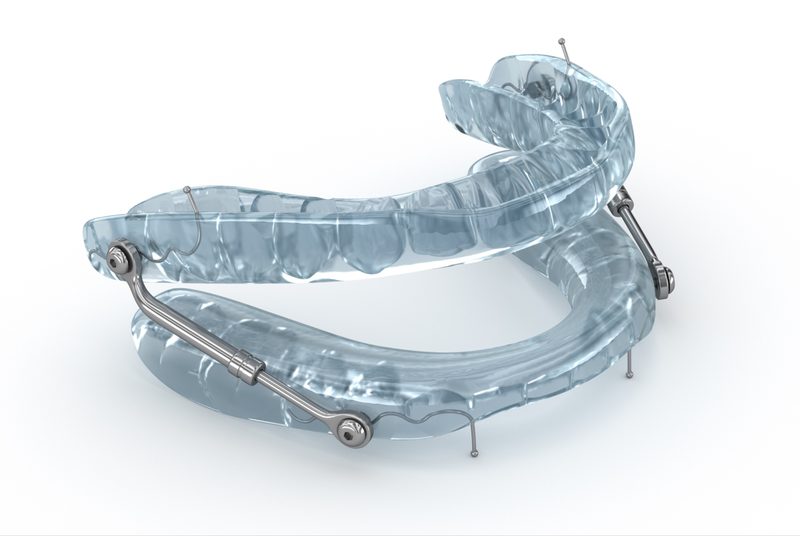
A mandibular advancement device — commonly referred to as a MAD, and sometimes called a mandibular advancement splint or oral appliance — is a custom-fitted dental device worn during sleep that gently holds the lower jaw in a slightly forward position. This small but precise repositioning of the jaw opens the airway at the back of the throat, reducing or eliminating the obstruction and vibration that cause snoring and sleep apnea.
Mandibular advancement devices are worn in the mouth during sleep — similar in appearance to a sports mouthguard or orthodontic retainer — and are removed upon waking. They are discreet, portable, and silent, making them a highly practical alternative to other forms of sleep apnea treatment for many patients.
Oral appliance therapy for sleep-disordered breathing is a recognized and well-researched field of dental practice. Dentists who provide this treatment — sometimes called dental sleep medicine practitioners — work closely with sleep physicians to ensure patients receive a comprehensive and medically appropriate approach to their care.
Mandibular advancement devices are primarily used to treat two closely related conditions: snoring and obstructive sleep apnea.
Snoring
Snoring occurs when the soft tissues at the back of the throat — including the soft palate, uvula, and tongue — relax during sleep and partially obstruct the airway. As air is forced through the narrowed passage, these tissues vibrate, producing the characteristic sound of snoring. While snoring is not always a sign of a serious medical condition, it can be disruptive to both the snorer and their sleep partner, and it is frequently associated with obstructive sleep apnea.
By gently advancing the lower jaw, a mandibular advancement device tightens and stabilizes the soft tissues of the throat, reducing the vibration that causes snoring. Many patients experience a dramatic reduction or complete elimination of snoring with oral appliance therapy.
Obstructive Sleep Apnea
Obstructive sleep apnea — commonly abbreviated as OSA — is a serious and highly prevalent sleep disorder in which the airway repeatedly collapses or becomes completely blocked during sleep, causing the patient to stop breathing for periods of ten seconds or longer. These breathing pauses — called apneas — can occur dozens or even hundreds of times per night, causing the brain and body to be repeatedly jolted from deep sleep to a lighter state in order to reopen the airway and restore breathing.
Most patients with OSA are entirely unaware that these events are occurring. Common signs and symptoms include:
- Loud, chronic snoring — often interrupted by gasping or choking sounds
- Witnessed pauses in breathing reported by a bed partner
- Waking with a dry mouth, sore throat, or headache
- Excessive daytime sleepiness — falling asleep during routine activities such as reading, watching television, or driving
- Difficulty concentrating, memory problems, or irritability
- Waking frequently during the night to urinate
- Restless or unrefreshing sleep despite spending adequate time in bed
- Morning headaches caused by reduced oxygen levels during sleep
Left untreated, obstructive sleep apnea carries significant health consequences. It has been strongly associated with an increased risk of high blood pressure, heart disease, stroke, atrial fibrillation, type 2 diabetes, depression, and motor vehicle accidents caused by drowsy driving. Treating OSA is therefore not simply a matter of improving sleep quality — it is a meaningful investment in long-term health and safety.
Mandibular advancement devices are recommended as a primary treatment for mild to moderate OSA and as an alternative treatment for patients with severe OSA who are unable to tolerate the more commonly prescribed CPAP therapy.
Upper Airway Resistance Syndrome
Upper airway resistance syndrome — UARS — is a condition that falls between simple snoring and frank sleep apnea. Patients with UARS experience increased resistance to airflow during sleep that causes repeated microarousals — brief interruptions of deep sleep — without the complete breathing pauses seen in OSA. Symptoms closely mirror those of sleep apnea, including daytime fatigue, unrefreshing sleep, and difficulty concentrating. Mandibular advancement devices can be an effective treatment for this condition as well.
Snoring and Sleep Apnea in Special Populations
Mandibular advancement devices are particularly well suited for certain groups of patients:
- CPAP-intolerant patients: Continuous positive airway pressure — CPAP — is widely considered the gold standard treatment for moderate to severe OSA and works by delivering a continuous stream of pressurized air through a mask worn over the nose or face during sleep to keep the airway open. While CPAP is highly effective, many patients struggle to tolerate the mask, the pressure, the noise, or the sensation of forced air — and studies consistently show that a significant proportion of prescribed CPAP users are not using their devices adequately. For these patients, a mandibular advancement device offers a proven and far more comfortable alternative that they are much more likely to use consistently.
- Frequent travelers: CPAP machines require a power source, are bulky to transport, and require distilled water for the humidifier. A mandibular advancement device fits in a small case and can be used anywhere — making it ideal for patients who travel frequently for work or leisure.
- Patients with positional sleep apnea: Some patients experience OSA primarily or exclusively when sleeping on their back. Mandibular advancement therapy can be particularly effective in this group.
- Patients with mild to moderate OSA: Current clinical guidelines from sleep medicine organizations support oral appliance therapy as a first-line treatment for mild to moderate obstructive sleep apnea, either as a primary option or when CPAP is not tolerated or preferred.